The Breathing Island
In Gyaros, memory is asymmetrically more important than sustainability. In this sense the island’s strong history demands that any intervention remains silent, honoring more the degradation of the ruins than the “natural” environment. The most interesting process deals with the deterioration of the built parts of this prison island from the natural powers that tend to erase it. The protection of some endangered species leads in the same direction: both history and ecology ask for a minimum operation.
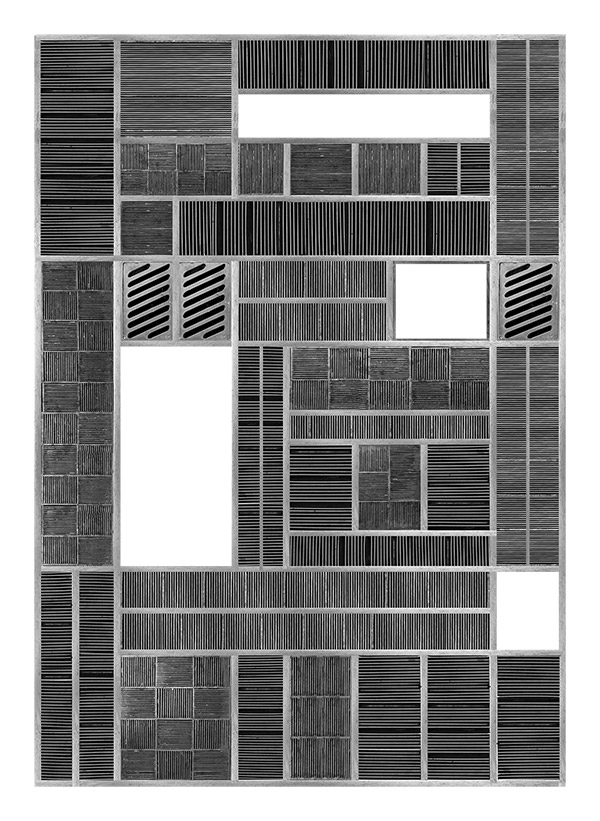
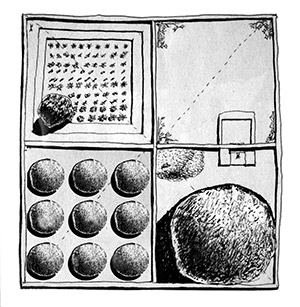
The project is framed as a sequence of few visits, small-scale interventions, and curated landscapes. Gyaros, a place of exile and suffering, will have to remain faithful to the gravity of its past. The proposal is not an intervention that overwrites the existing narrative, but a framework for seeing it differently, allowing the memory of this sad monument to persist. In this sense the project has to be firstly read as a critique to any intervention that normalizes oblivion and challenges the silence of the place. The Breathing Island was a project within and against the competition of Alumil for the sustainable future of Gyaros, meant to be rejected by the jury, as it was.
The Prison Museum is in this sense left as such, while two simple new through-openings allow access to the landscape as an interruption of the visitor route. An exhibition within the existing space is proposed to operate as a curated museum related to the prison itself.
The old warehouse is also repaired partially and left as a flexible venue for conferences, projections, screenings, theater performances, and exhibitions. Its simple interior allows fluid adaptation to different programs.
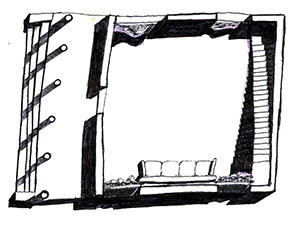
The space of the power plant was used for an architectural transformation in section that was allowing a common room for visitors.
Fewer than half of the residential units were proposed as shelters at the northern part of the island: five units for researchers and visitors were planned for the guards of the island and researchers.
A single gesture is placed far from the prison: a tall, empty scaffolding structure near the sea, embodying incompleteness. Through mist generated from desalinated water, it becomes a temporary atmospheric marker, a subtle signal to passing ships.
Gyaros is not a place to be revived, but to be read—continuously and openly. Its meaning remains plural, uncertain, and alive. Silence becomes the necessary frame for this multiplicity.
The intervention is minimal: a few shelters, the transformation of the power plant into a visitors’ center, and a simple gathering space. The prison remains a museum of itself, preserved through minimal, almost archaeological intervention, safeguarding the power of this symbol.
Title:
The Breathing Island
Credits:
ANTONAS OFFICE
Aristide Antonas, Elina Axioti, Alexandros Bouris, Υannikos Vasiloulis